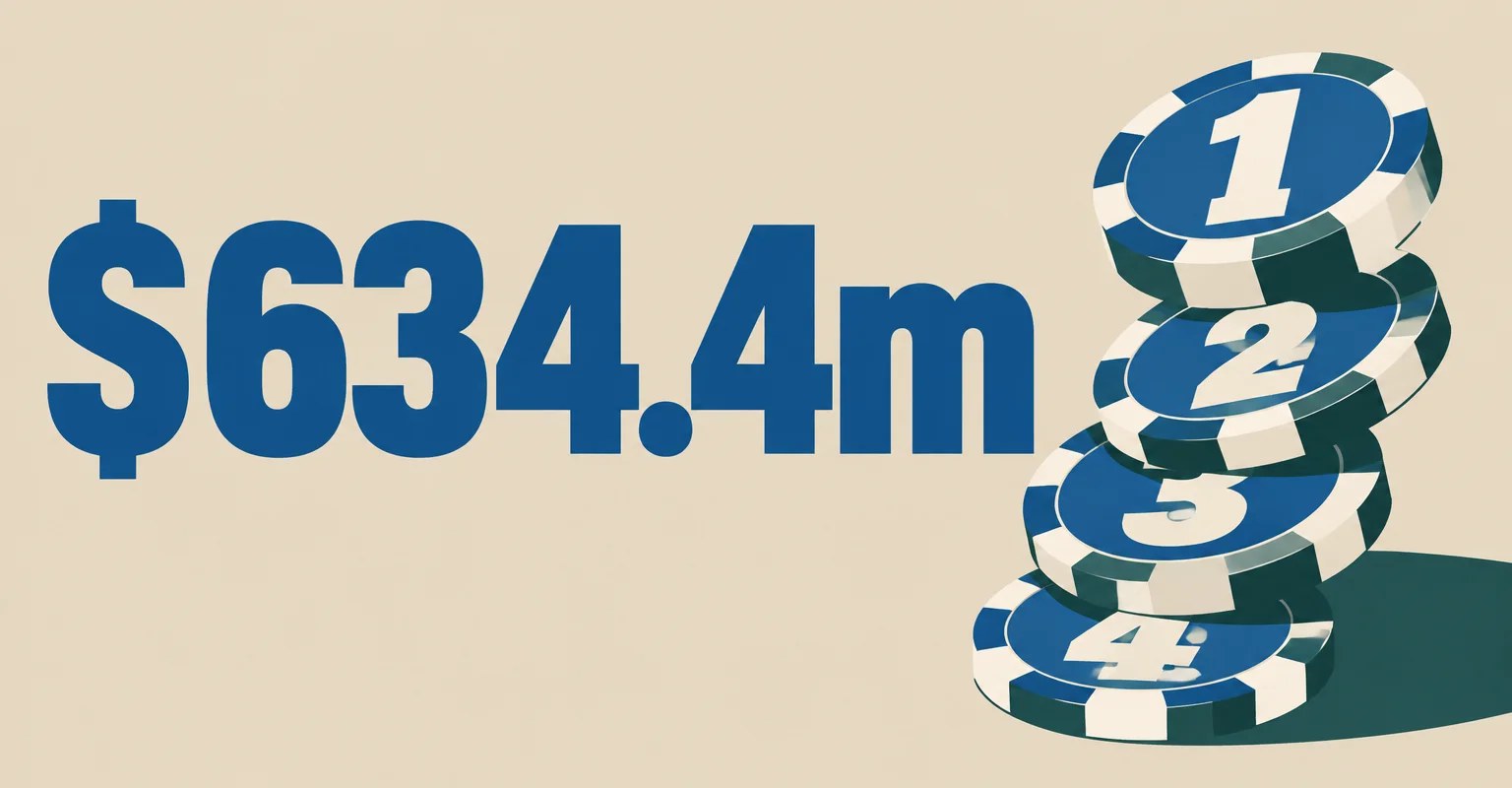
Pennsylvania’s combined gaming and fantasy-contest revenue reached a monthly record of $634.4 million in October, up 6.3% from a year earlier and above the previous high of $625.5 million set in May. The Pennsylvania Gaming Control Board said the result generated a record $274.1 million in gaming and fantasy-contest taxes.
The October total exceeded the $597.0 million reported in October 2025. As we reported after September’s results, Pennsylvania had generated $555 million in combined gaming revenue that month, with online casino games already the largest contributor.
Online casino-type gaming set a new high of $278.8 million in October, an annual increase of 11.1%. That surpassed the previous iGaming record of $259.7 million, reached in December 2025.
Online slots produced $218.1 million, rising 14.3% year on year and clearing their May record of $202.5 million. Online table games added $58.5 million, up 1.3%.
Online poker was the exception within iGaming. Revenue fell 9.0% from October 2025 to about $2.3 million, following a 1.8% annual decline in September. The October figure was nonetheless marginally higher than September’s roughly $2.27 million.
Land-based slot machines generated $214.9 million, up 5.6% from a year earlier, while retail table-game revenue dropped 9.4% to $68.9 million. The state’s 18 land-based casinos operate alongside online casino games, retail and online sports wagering, truck-stop video gaming terminals and online fantasy contests.
Sports-wagering revenue rose 7.3% year on year to $65.1 million, even as the amount wagered fell 6.7% to $903.0 million. The implied sportsbook hold was about 7.2%, compared with 6.3% a year earlier.
October’s sports handle was 13.1% higher than September’s $798.7 million, while sports-betting taxable revenue rose 45.5% from $44.7 million. Online sportsbooks accounted for about $867.2 million, or 96%, of October wagers, according to PlayPennsylvania; retail sportsbooks took $35.8 million.
Video gaming terminals generated a record $4.9 million, up 39.0% from a year earlier and above the prior high set in March. By the end of October, operators offered five machines at each of 71 qualified truck-stop establishments. Fantasy-contest revenue, meanwhile, fell 15.7% to about $1.8 million.